
Why Daily Movement Is the Most Underrated Health Habit

If you could bottle a single habit that improved your mood, sharpened your focus, protected your heart, helped you sleep and added healthy years to your life, it would be the most sought after prescription on earth. The remarkable thing is that it already exists, and it doesn't come in a bottle. It comes from movement.
At ReDefined, "Natural Movement" isn't a slogan we printed on a wall. It's the principle the entire hub is built on. And it's backed by a growing body of research showing that regular physical activity is one of the most powerful preventative tools we have. In a world that increasingly asks us to sit still, at a desk, in a car, on the couch, the simple act of moving your body has quietly become one of the most valuable things you can do for your long term health.
What the science actually says
Decades of research consistently link regular movement to a lower risk of heart disease, type 2 diabetes, several cancers, and cognitive decline. Movement supports better mental health too. Physical activity is widely recognised as an effective way to reduce symptoms of stress, anxiety and low mood, and it can be a powerful complement to other forms of care. It improves sleep quality, supports healthy blood pressure, and helps maintain strength, mobility and balance as we age, which is one of the biggest factors in staying independent and active later in life.
What's striking is how broad the benefits are. There are very few interventions, medical or otherwise, that positively affect so many different systems of the body at once. Movement works on your heart, your metabolism, your brain, your mood and your sleep, all at the same time. It is, quite literally, whole body medicine.
Crucially, you don't need to train like an athlete to benefit. The biggest health gains show up when people go from doing very little to doing something regularly. Consistency, not intensity, is where the magic lives. A gentle walk most days, a couple of classes a week, a bit of strength work to keep your muscles strong: these ordinary habits, repeated over time, are what move the needle. You do not have to punish yourself to be well.
Learning from the world's healthiest communities
Some of the most compelling evidence for natural movement comes from studying the places where people live the longest, healthiest lives. In these communities, movement is not something people schedule or force. It is simply woven into the rhythm of their days. They walk to see friends, they garden, they work with their hands, they move often and gently from morning until night.
The lesson is not that we all need to move to a village on a hillside. It is that our bodies are designed to move regularly, and that the healthiest approach is to build movement back into everyday life rather than treating it as a chore to tick off. Take the stairs. Walk for your coffee. Stretch between meetings. Then add structured movement you genuinely enjoy on top. Every bit counts, and it adds up faster than you would think.
Why "preventative" is the key word
Most of us were raised to think of healthcare as something we reach for once something has gone wrong. We wait for the pain, the diagnosis, the wake up call, and only then do we act. But the most meaningful results come from preventing problems before they start. Movement is preventative medicine: every walk, every class, every session is a small deposit into your long term health account.
This is exactly why we describe ReDefined as more than a gym, our philosophy goes beyond fitness. Training is one ingredient, but recovery, mobility, nutrition and mindset all matter too. When they work together, the results compound. A strong body that never rests will eventually break down. A great workout undone by poor sleep and constant stress will only take you so far. Real, lasting health comes from looking after the whole picture, and that is exactly what we have built our hub to support.
Recovery is part of the work
One of the biggest shifts in how we understand health is the recognition that recovery is not a reward for training. It is part of training. Rest, mobility and deliberate recovery are what allow your body to adapt, repair and come back stronger, and they help protect you from the burnout that causes so many people to give up.
That is why recovery sits at the heart of ReDefined rather than as an afterthought. Time in the sauna, contrast therapy, gentle mobility work and quality sleep are not indulgences. They are essential parts of a sustainable, lifelong approach to movement. When you treat recovery as seriously as you treat your training, you can keep moving well for far longer.
Finding a form of movement you'll actually keep doing
The "best" exercise is the one you enjoy enough to keep coming back to. That's why our hub offers five distinct spaces rather than a single room of machines:
If you love intensity, the Performance Studio runs HIIT, HIRT, MetCon and athletic conditioning.
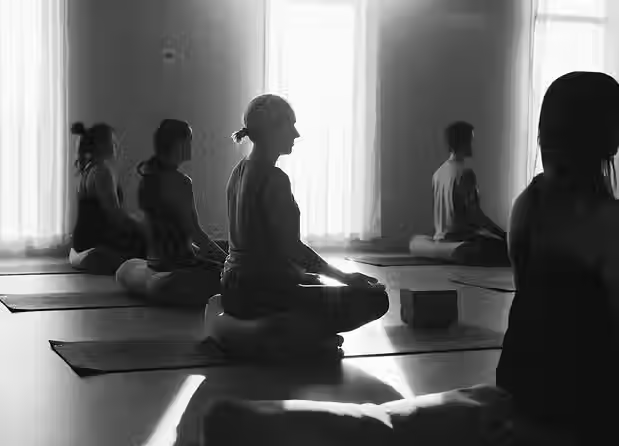
If you want to slow down and reconnect, the Mindbody Studio is home to world class hot yoga.
If you're after control and precision, the Movement Studio offers reformer and mat Pilates, Barre and more.
If you like training on your own terms, the Open Gym is open and ready.
And when it's time to rest, the Recovery Room has infrared sauna, compression and contrast therapy waiting.
The point isn't to do everything. It's to find your thing, and to have somewhere that supports you when your needs change. The type of movement that suits you at thirty may not be the same at fifty, and life has a way of shifting our goals, our bodies and our schedules. Having variety under one roof means you never have to start over. You simply adjust.
The quiet power of community
There is one more ingredient that makes movement stick, and it has nothing to do with equipment. It is the people around you. Moving alongside others, sharing the effort, being greeted by name, feeling part of something: this is what turns a good intention into a lasting habit. Community keeps us accountable, it makes the hard days easier, and it makes the whole experience something to look forward to rather than something to endure. When you find your people, showing up stops feeling like discipline and starts feeling like belonging.
How to start (without overhauling your life)
Start small and specific. Choose two or three sessions a week and book them in like any other appointment. Pick a class you're genuinely curious about. Tell someone you're going, because accountability helps. And give yourself permission to be a beginner. Everyone in the room started somewhere, and the person who looks completely at home today was once walking in for the very first time.
Do not wait to feel ready or fit enough to begin. Movement is how you get there, not something you earn the right to do. If you're not sure where to start, that's what we're here for. Come in for a free tour, talk to our team, and we'll help you find a starting point that fits your body, your goals and your week.
Natural movement is medicine. The good news is the first dose is closer than you think.
Jimmy
ReDefined Founder



Comments