
Best Exercises for Full Body Strength, Fitness and Everyday Movement


Finding the best exercises for full body training does not mean doing dozens of different movements in every workout. A well-planned full body workout can combine a few key exercises that train the legs, hips, back, chest, shoulders and core.
Full body strength exercises can also help you build useful movement patterns for everyday life. Whether you are lifting groceries, climbing stairs, playing sport or simply wanting to move with more confidence, training the whole body can provide a practical foundation.
For people looking for a gym in Papamoa, the key is to choose exercises that match your current ability, goals and experience. At ReDefined, movement is approached as part of a wider wellbeing routine, with functional training, Reformer Pilates, yoga, open gym and recovery options available within one wellbeing hub.
What Makes a Full Body Exercise Effective?
The most useful full body exercises usually involve more than one joint or muscle group. These are often called compound exercises.
For example, a squat involves the hips, knees and ankles while working the lower body and requiring the trunk to stay controlled. A deadlift pattern trains the hips and legs while also challenging the back and core.
This makes compound movements useful for people who want efficient complete body workouts without spending hours in the gym.
Movement pattern | Example exercise | Main areas trained |
Squat | Goblet squat | Legs, glutes and core |
Hinge | Romanian deadlift | Hamstrings, glutes and back |
Push | Push-up | Chest, shoulders, arms and core |
Pull | Row | Back, shoulders and arms |
Carry | Farmer carry | Grip, core, shoulders and legs |
Brace | Plank | Core and trunk |
The goal is not simply to lift more weight. Good technique, controlled movement and gradual progression are important parts of effective training.
1. Squats for Lower Body Strength
Squats are one of the most accessible functional exercises for developing lower body strength.
Your legs and hips are involved whenever you sit down, stand up, climb stairs or lower yourself towards the ground. Squatting therefore has a clear connection with everyday movement.
Beginners can start with a bodyweight squat before progressing to a goblet squat or another loaded variation. The important point is to choose a version that allows you to maintain control throughout the movement.
You can adjust the depth, resistance and tempo as your ability develops. A coach can also help you understand how your stance, mobility and technique affect the movement.
2. Hip Hinge Exercises for Stronger Hips and Hamstrings
The hip hinge is another important movement pattern.
Romanian deadlifts, kettlebell deadlifts and similar movements teach you to bend from the hips while maintaining control through the trunk. They can strengthen the posterior chain, including the hamstrings and glutes.
Learning the hinge pattern can also make everyday lifting more controlled. Instead of simply bending through the back, you learn to use the hips and legs to create movement.
If you are new to strength training, start with a light resistance and focus on technique. Increasing resistance should come after you are comfortable with the movement.
3. Push-Ups for Upper Body and Core Strength
Push-ups are a simple example of an exercise that trains several areas at once.
They primarily challenge the chest, shoulders and arms, while the core works to keep the body stable. This makes the push-up a useful addition to a full body gym workout.
There are several ways to adjust the exercise. You can perform an incline push-up with your hands on a stable elevated surface, use a standard push-up or gradually progress towards more challenging variations.
The best option is the one that allows you to maintain good alignment and controlled repetitions.
4. Rows for Back and Postural Strength
A balanced programme should include pulling movements as well as pushing movements.
Rows can train the upper back, rear shoulders and arms while requiring the trunk to remain stable. They can be performed with dumbbells, cables, resistance bands or other equipment.
For a complete body workout, combining a pushing movement with a pulling movement helps create a more balanced training session.
At ReDefined, strength training classes are part of a broader functional training approach designed around real-world movement and strength development.
5. Lunges for Strength, Stability and Coordination
Lunges introduce a single-leg element to your training. They can challenge the legs and glutes while also requiring balance and coordination.
You can perform forward lunges, reverse lunges or split squats depending on your experience and goals.
Single-leg exercises can be particularly useful because many everyday movements are not performed with both feet doing exactly the same thing. Walking, climbing stairs and changing direction all require coordination between the two sides of the body.
Start with a bodyweight variation before adding resistance.
6. Carries for Practical Full Body Fitness
Loaded carries are simple but demanding. A farmer carry, for example, involves walking while holding weights at your sides.
The exercise challenges your grip, shoulders, core and legs. It also requires you to maintain a stable posture while moving.
This is a good example of functional fitness because the movement combines strength and locomotion. Rather than isolating one muscle, you are asking several areas of the body to work together.
Carries can be adjusted by changing the load, distance or duration.
7. Planks and Other Core Exercises
Your core does more than create visible abdominal definition. It helps transfer force between your upper and lower body and contributes to stability during many movements.
Planks are one option for developing core control. Other useful choices include dead bugs, bird dogs and controlled carries.
Rather than performing endless repetitions, focus on maintaining good control. Your goal should be to resist unwanted movement while breathing steadily.
Core exercises can then support larger movements such as squats, rows, lunges and presses.
How Functional Training Brings These Exercises Together
Individual exercises become more useful when they are combined into a structured programme.
This is where functional training Papamoa can be useful for people who want more than a collection of exercises. Functional training can combine strength, conditioning, mobility and movement skills in a session designed around how the body works as a whole.
For someone searching for strength training near me, this type of approach can provide a way to work on multiple movement patterns within the same programme.
Likewise, group fitness classes can provide structure and coaching while allowing people to train alongside others.
Should You Add HIIT to a Full Body Workout?
High-intensity interval training, or HIIT, can be included in a wider fitness routine, but it does not need to be the focus of every session.
HIIT workout classes often combine short periods of harder effort with recovery periods. Depending on the programme, exercises can include bodyweight movements, cardio-based drills and resistance exercises.
If you are new to training, it is sensible to establish basic movement skills before making every workout highly intense.
Fitness is not only about how hard you can train. Recovery, consistency, movement quality and appropriate progression all matter.
How Often Should You Do Full Body Strength Training?
The right training frequency depends on your current fitness, schedule, goals and recovery. A structured weekly routine can help you balance strength development with mobility, conditioning and recovery.
For general health, adults should aim for at least 150 minutes of moderate-intensity aerobic activity each week, or an equivalent amount of more vigorous activity. Muscle-strengthening activities involving the major muscle groups should also be included on at least two days each week.
At ReDefined, a weekly training structure can include three dedicated strength days alongside mobility, conditioning and recovery. This gives you opportunities to work on strength consistently while allowing different types of movement and recovery throughout the week.
For example, a sample week could look like this:
Day | Training focus |
Monday | Full body strength |
Tuesday | Mobility |
Wednesday | Full body strength |
Thursday | Conditioning |
Friday | Full body strength |
Saturday | Recovery |
Sunday | Light movement or gentle mobility |
This schedule is only an example and can be adjusted according to your training experience, goals and recovery needs. The aim is to create a balanced routine rather than making every day a high-intensity training day.
Combine Strength With Mobility and Movement
Strength is only one part of physical fitness.
A balanced weekly routine can combine strength training with mobility, conditioning and lighter movement. Mobility sessions can help you work through the positions required by your training, while conditioning can develop cardiovascular fitness and exercise capacity.
This is why some people choose to combine strength training with Pilates or yoga.
For people interested in Pilates reformer classes, Reformer training can provide another way to develop movement awareness, core control and strength alongside a broader training routine.
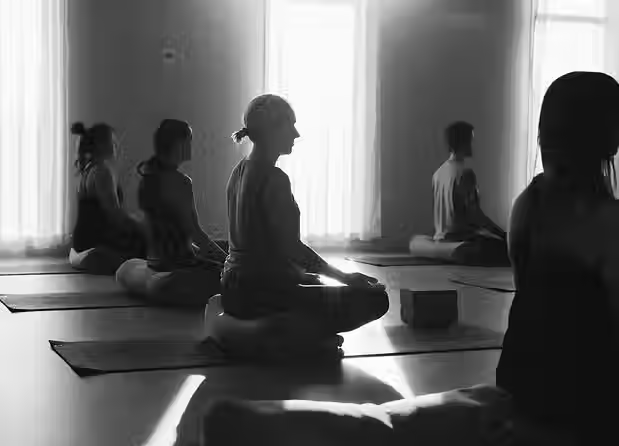
Yoga can also complement strength work by providing opportunities to focus on mobility, breathing and controlled movement. ReDefined's MindBody Studio offers different yoga styles, meditation, breathwork and related sessions.
Rather than trying to make every session a full workout, you can use different days for different training goals. For example, Monday, Wednesday and Friday can focus on strength, while Tuesday can be dedicated to mobility and Thursday to conditioning.
Don't Forget Recovery
Training creates a physical demand on your body, so recovery should form part of your overall routine.
A weekly schedule that includes dedicated recovery can help you avoid making every training day physically demanding. Sleep, nutrition, rest days and appropriate training volume all contribute to recovery.
A sample week at ReDefined includes Saturday as a dedicated recovery day, while Sunday can be used for light movement or gentle mobility. This provides opportunities to stay active without treating every day as a strength or conditioning session.
Some people also choose additional recovery services after demanding training sessions.
If you are searching for an ice bath near me, infrared sauna near me or compression therapy near me, these services can be considered alongside your wider training routine rather than as a replacement for good recovery habits.
The right approach depends on your training load and individual circumstances.
Build a Stronger Approach to Movement
The best exercises for full body training are not necessarily the most complicated ones. Squats, hinges, pushes, pulls, lunges, carries and core movements can form the foundation of an effective programme.
From there, you can build variety through functional training, Pilates, yoga, conditioning and recovery.
A structured weekly routine can help bring these different elements together. For example, you might use Monday, Wednesday and Friday for full body strength, Tuesday for mobility, Thursday for conditioning, Saturday for recovery and Sunday for light movement or gentle mobility.
The most important step is finding an approach you can perform consistently and progress safely. If you are looking for a health and fitness club in Papamoa where different movement and wellbeing options are connected, ReDefined provides multiple training spaces and services within one hub.
Contact ReDefined today to discuss your training and wellbeing options in Papamoa.


Comments